Instrumentation:
Woodwinds
2 Piccolo / 1 Alto Recorder in F – 2 parts
4 Flute – 2 parts
2 Oboe – 2 parts
2 English Horn – 2 parts
2 Eb Clarinet – 2 parts
6 Bb Clarinet (2-1st, 2-2nd, 2-3rd) – 3 parts
2 Bass Clarinet – 2 parts
2 Contrabass Clarinet – 2 parts
4 Bassoon – 2 parts
2 Contrabassoon – 2 parts
Brass
8 Horns in F (2-players each) – 4 parts
6 Bb Trumpet (2-1st, 2-2nd, 2-3rd) – 3 parts
6 Trombone (2-1st, 2-2nd, 2-3rd) – 3 parts
2 Bass Trombone – 2 parts
2 Tuba – 2 parts
Percussion – Pitched
5 Timpani (32″, 30″, 29″ or 28″, 26″ or 25″, 23″ or
20″) – 1 part
1 Chimes (Tubular Bells)
1 Marimba (Single Clef)
1 Xylophone
1 Vibraphone
1 Glockenspiel
1 Crotales
Percussion – Unpitched
1 Bass Drum
1 Snare Drum
1 set Concert Toms (High, Medium, Low)
1 pair Crash Cymbals
1 Suspended Cymbal
1 Hi-Hat (with Foot Pedal)
1 Tam-Tam (Gong)
1 set Temple Blocks (High, Low)
Percussion – Marching
1 Marching Snare
1 set Tenor Drums (4 + 2 spock)
1 Marching Bass Drum
1 pair Marching Cymbals
Incidental
1 Triangle
1 Rachet
1 Sleigh Bells
1 Mark Tree
1 Tambourine
Harp – 2 parts
1 Harp (2 would be better)
Keyboards
1 Grand Piano
1 Pipe Organ (or Hammond or other
electronic organ with pipe settings)
1 Clavinet
1 Celeste
Strings (10–10–8–10–6)
10 – 1st Violins – 5 parts
10 – 2nd Violins – 5 parts
8 Violas (4-1st, 4-2nd) – 4 parts
10 Violoncello (5-1st, 5-2nd) – 5 parts
6 Contra Bass (Double Bass) (3-1st, 3-2nd) –
3 parts
(Approximately 105 to 110 Players)
Shorthand:
2(2pic)+1Frec.4(fl).4(ob).2(ehrn).2(Ebcl).6(Bbcl).2(bscl).2(cnbscl).4(cbn).2(cnbn) / 8(Fhrn).6(Bbtpt).6(tmbn).6(bstrbn).2(tuba) / 5(timp).4(perc).4(mallet).4(marching perc) / 1(hp) / 1(kybds) / str
March to the Gates of the Sun
Program Note:
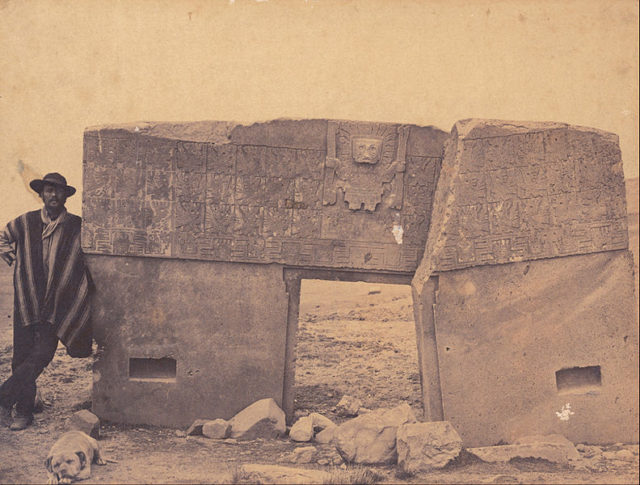
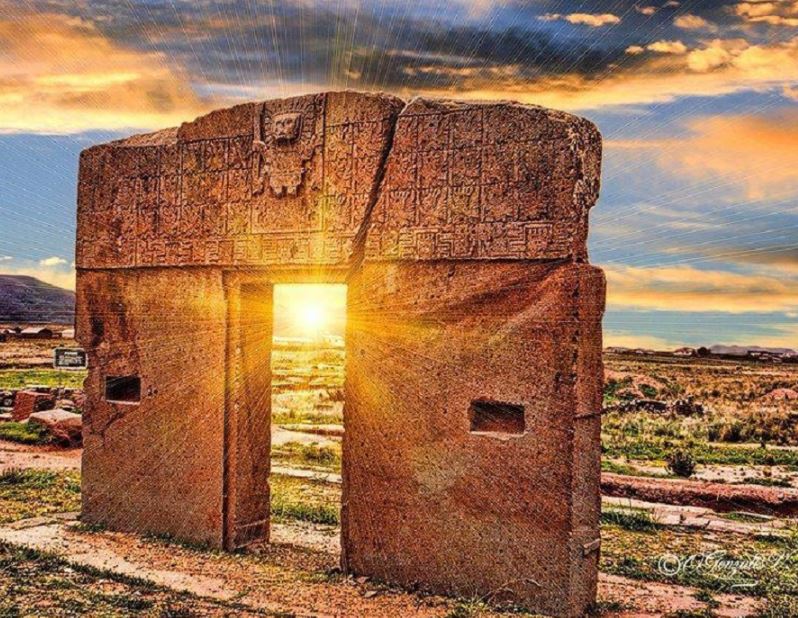
“March to the Gates of the Sun” was first conceived around 1976 as a mythical interpretation of a PBS documentary about the Gate of the Sun from the South American Tiwanaku culture, a necklace pendant of the Sun Calendar of the Aztec, and some inspiration from 1950 Hollywood Historical Epics featuring Ancient Rome, Greece and a touch of Egypt.
Tiwanaku is located near Lake Titicaca, which is near modern-day La Paz, Bolivia. The piece was originally orchestrated for an Orchestral Rock (early Progressive Rock) Band. Many years later, the piece was reworked as an Electronic Realization (sorry Larry). Finally, in 2024 I decided to orchestrate the work for a full orchestra, which was how it was always meant to be presented.
Friday Anne Keyes-Allen
Warminster, PA, USA
28 August 2025
Performance Notes:
1. The opening Bb Clarinet solo should be left to the Clarinetist to express their self at will, as long as all of the notes are played in relative order.
2. For my use of “a2”; basically, everyone on the part plays in unison.
3. The “Alto Recorder in F” in the Finale may be substituted with any Recorder, provided you perform any necessary transposition. If no Recorders or Recorder Player are available, then substitute with a Flute.
4. The Score calls for 5 Timpani, but 6 would be better, if available, to alleviate some of the fast tunings.
5. For Organ sections; several kinds of Organs are listed, but the original concept was for a Hammond or Hammond-like Percussive Organ sound. However, any percussive organ of your choice will do. If a passage calls for a Rotary Organ, your organ, run through a rotating speaker system, or either software or hardware rotating effect, would be acceptable.
6. If your organization does not have access to a Clavinet, a software Clavinet is acceptable.
7. One Harp is great, two is better. The players may play in unison, or divide the part between the players as they see fit. (Two Harp parts are provided if shipping with full set of parts.)
8. For the “Street Break” section; having a full Marching Drum Line (in uniform, of course) vamping on the Street Break while marching from off-stage right or left to the opposite side would be awesome, but I leave this up to the Conductor and organization management to make this decision.
9. Small ensembles may double-up on any instruments necessary to cover all parts.
Finally, to the Conductor; please feel free to add your own touch and interpretation to this work.
Contents:
i. March – measures 1 – 273
ii. Innocence – measures 274 – 295
iii. Separate Searching Feelings – measures 296 – 330
iv. Sign Here – measures 331 – 436
v. The Gates – measures 437 – 475
vi. Sign Here – Reprise – measures 476 – 524
vii. Attack – measures 525 – 554
viii. Innocence – Reprise – measures 555 – 615
ix. Street Break – measures 616 – 628
x. Silver Sea – measures 629 – 686
xi. Walk in the Light – measures 687 – 718
xii. Grand March – Rejoyce – measures 719 – 742
xiii. Finale – finally? – measures 743 – 803
xiv. fine.